

Archives

  • Planetary Research cover for the August 2026 issue

    August (2026)
    Vol. 1 No. 1

    Cloud belts in the southern hemisphere of Jupiter as seen by NASA's Juno spacecraft. This image was taken by JunoCam on December 16, 2017 during the spacecraft's tenth perijove pass of the planet. When the image was taken, the spacecraft was about 13,600 km above the cloud deck at a latitude of 28° South. The radius of Jupiter is 69,886 km, which is 11 times larger than Earth, and the spatial resolution of the image is about 9 km. Credit: NASA/JPL-Caltech/SwRI/MSSS, image PIA21974.

    Full resolution cover

  • Planetary Research cover for the October 2026 issue

    October (2026)
    Vol. 1 No. 3

    Phobos, the larger of Mars’s two moons, as imaged by the HiRISE camera on NASA’s Mars Reconnaissance Orbiter. The moon measures roughly 20 km in diameter and its most prominent feature is the 9-km-wide Stickney crater. Phobos will be explored by the Martian Moons eXploration (MMX) mission that was launched on 19 October 2026. The spacecraft will reach its target in 2029 and return samples to Earth in 2031. The MMX mission is led by JAXA (Japan Aerospace Exploration Agency), with participation from NASA, CNES (France), DLR (Germany), and the European Space Agency (ESA). Image credits: NASA/JPL-Caltech/University of Arizona (PIA10368).

  • Planetary Research cover for the September 2026 issue

    September (2026)
    Vol. 1 No. 2

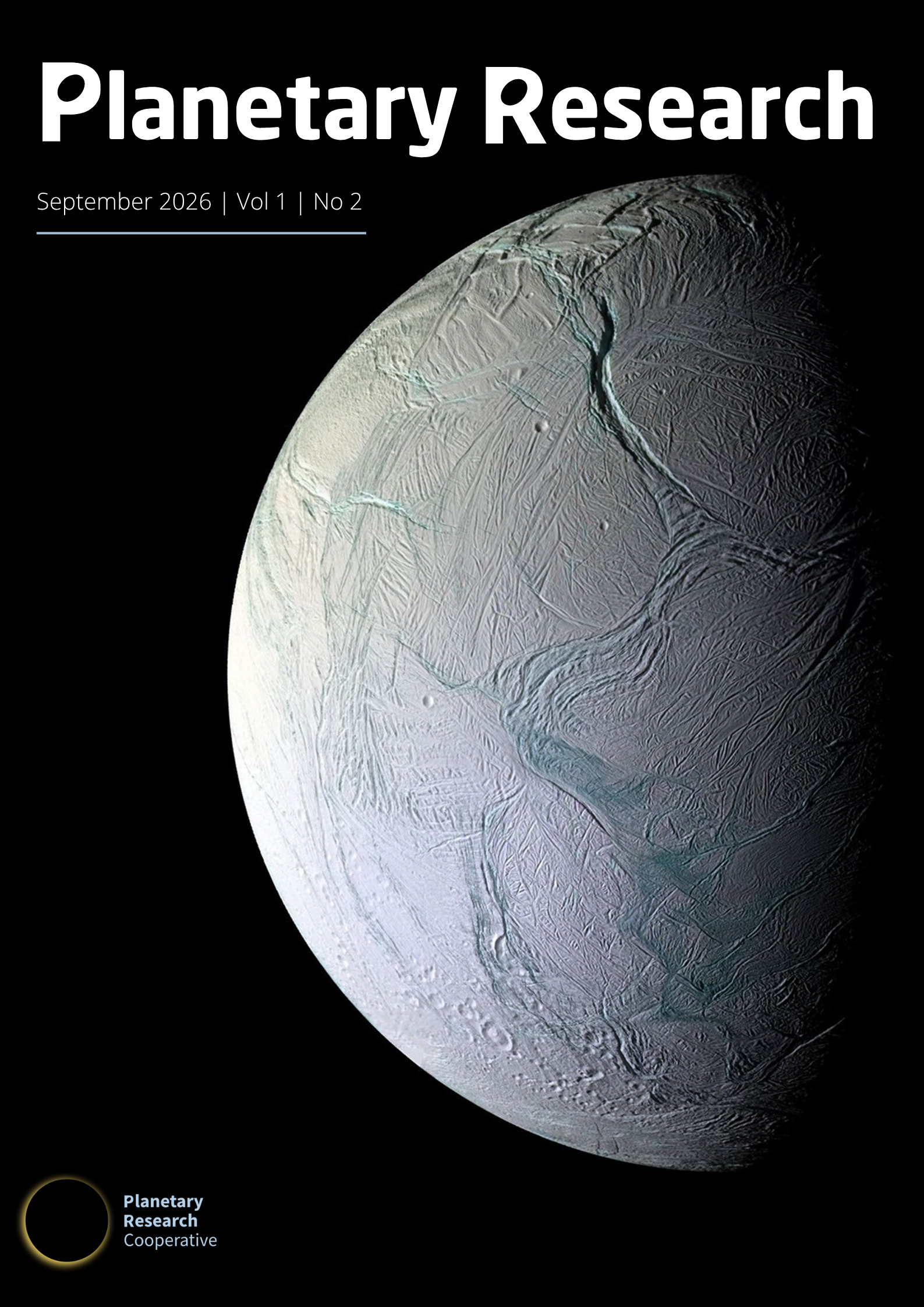
    A Cassini mosaic of Enceladus, Saturn’s ice-covered moon, created from images taken during the spacecraft’s flyby on 9 October 2008. Recent tectonic activity is evidenced by fractures and ridges, with a one-kilometer deep chasm (Labtayt Sulci) running through the upper half of this enhanced-color image. The diameter of the moon is 504 km, and the resolution of the images used in constructing this mosaic are as high as 180 meters. Credit: NASA/JPL/Space Science Institute, image PIA11133.

    Full resolution cover